Aalborg University - AAU Energy is set to create a new hybrid Energy Storage (HES) facility representing a pioneering advancement in scalable, controllable, modular, and flexible energy storage solutions. This cutting-edge facility addresses critical challenges in grid stability, power quality management, and future renewable energy integration while providing essential grid balancing services.
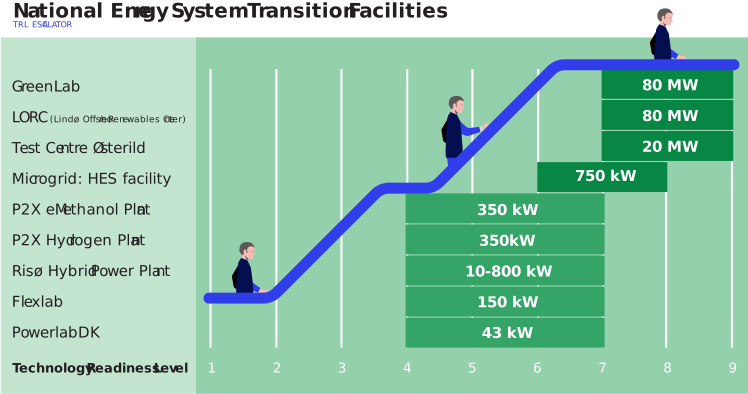
The HES facility integrates storage technologies, including Supercapacitors and Battery modules, coupled with Power Electronic interfaces, a Real-Time Digital Simulator, and a Linear Power Amplifier. Operating at a 750-kW capacity level, the facility is designed to:
- Stabilize power demand fluctuations from renewable energy sources
- Enable both grid-connected and islanded operational modes
- Support energy services and power system-level applications
The 750 kW-level HES facility intends to smoothen the demand for power from potential power plants (ROAD2X at AAU energy), quick chargers for EVs, and emulate load dynamics as well as to respond as a flexible and controllable block.
In addition, the facility integrates a multi-layered communication network for model and data exchange engineered for seamless integration with other NEST facilities. The communication architecture will follow a hierarchical, multi-layered design. At the local AAU level, a lightweight and modular communication framework will be deployed to facilitate low-overhead data acquisition and deterministic control operations. Inter-site communication will be coordinated via the global NEST data exchange orchestrator, implemented by a high-throughput, low-latency communication channel with end-to-end latency constrained to around 2-5 milliseconds. To ensure semantic and syntactic interoperability across all nodes, the system will employ standardized data and metadata schemas, compliant with common ontologies and machine-readable formats, thereby enabling seamless data exchange and orchestration across heterogeneous platforms.
Core capabilities
The HES facility is carefully designed to explore the benefits of combining different storage technologies in a coordinated way and a flexible fashion. By pairing energy-dense batteries with power-dense supercapacitors, the lab investigates how hybrid energy storage systems can meet rapid and dynamic power demands while also supporting longer-term energy needs. The facility is built to simulate conditions like fast-changing power flows and large-scale renewable energy input. The facility will serve as an AAU energy campus pilot site coupled with islanded or grid-connected scenarios and on-demand support. The facility will also serve as a comprehensive testing environment for advanced grid scenarios, including:
- Weak rural grid conditions
- Small island grid operations
- HVDC modeling and power systems scenarios (offshore wind farm applications)
- Grid-forming and islanding operational modes
- Fast-charging infrastructure emulation
- Emulation of wind farm, solar farm and PtX plants in the grid connected mode
- Load flexibility
- fault ride-through scenarios
- Emulation of sustainable carbon neutral local energy communities